
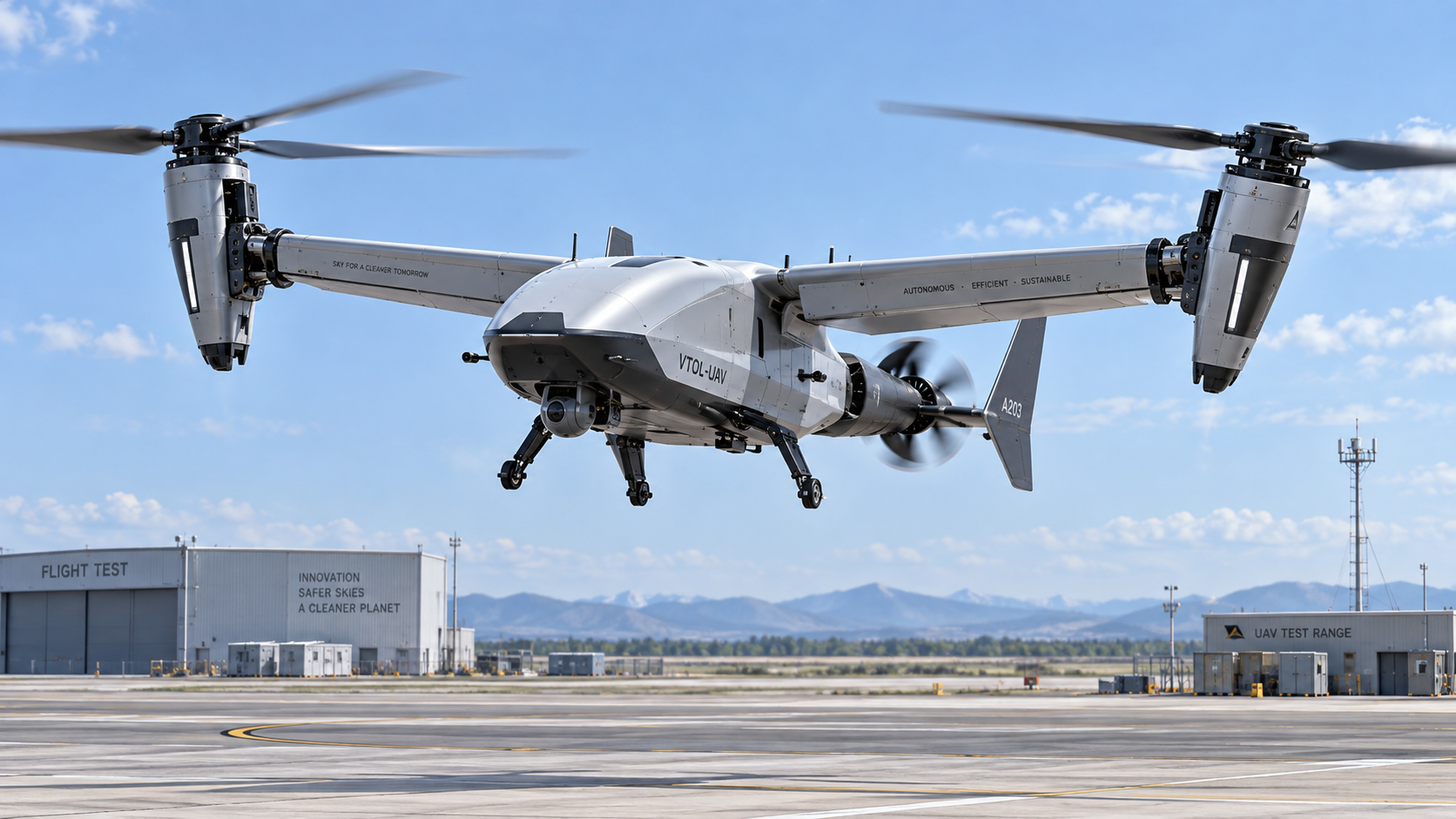
A VTOL UAV Propulsion System must shift from vertical lift to efficient forward cruise without sacrificing stability, control authority, payload safety, or mission endurance.
This transition depends on coordinated power management, thrust-vector control, airspeed feedback, and flight-control logic that continuously balances aerodynamic and propulsive forces.
The Core Challenge: Maintaining Control While Lift Sources Change
The central transition challenge is simple in principle but demanding in practice: rotor thrust initially supports the aircraft, then aerodynamic lift gradually takes over.
During hover, vertical propellers or lift rotors provide nearly all lift. During cruise, wings generate lift while propulsion mainly provides forward thrust.
Between those conditions, neither system can be assumed to carry the aircraft alone. The controller must manage an overlapping lift-sharing period.
If rotor thrust reduces too early, the UAV may lose altitude or enter an unstable attitude. If it remains excessive, energy consumption rises sharply.
A successful transition therefore is not merely a mechanical tilt event. It is a controlled exchange between vertical thrust, forward acceleration, and wing lift.
For operators, the most important outcome is predictable aircraft behavior. A stable transition protects payloads, improves mission reliability, and reduces operational risk.
For propulsion buyers, this means evaluating the complete VTOL UAV Propulsion System rather than comparing individual motor, engine, propeller, or rotor specifications alone.
How a VTOL UAV Propulsion System Is Typically Configured
Most VTOL platforms use one of three architectures: separate lift-and-cruise propulsion, tilt-rotor propulsion, or tilt-wing propulsion.
Separate lift-and-cruise designs use dedicated vertical rotors for takeoff and landing, plus a separate propulsion unit for forward flight.
These configurations simplify the transition because lift rotors remain vertical while a cruise propeller, electric motor, or UAV engine accelerates the aircraft forward.
Tilt-rotor aircraft rotate their propellers or nacelles from a vertical orientation toward a horizontal cruise position during the transition.
Tilt-wing aircraft rotate the wing and attached propulsion units together. They can offer compact integration but demand careful aerodynamic and control-system development.
Hybrid VTOL designs may combine internal-combustion engines, generators, batteries, electric motors, and dedicated lift systems to extend operational range.
Each architecture places different demands on the propulsion system. The best option depends on mission range, payload mass, launch environment, maintenance capability, and redundancy requirements.
For industrial or defense programs, architecture selection should begin with the mission profile rather than a preference for a particular powerplant technology.
What Happens During the Transition From Hover to Cruise
The transition usually begins after the UAV establishes a stable hover, verifies navigation conditions, and confirms sufficient power and control margin.
Flight-control software commands a gradual pitch change, rotor tilt, or activation of the cruise propulsion unit, depending on the platform configuration.
As forward speed increases, airflow over the wing produces lift. Airspeed sensors, inertial measurement units, GPS data, and attitude estimates inform the controller.
The system progressively reduces vertical thrust only after aerodynamic lift becomes dependable. This timing is critical because lift depends on airspeed, wing loading, and local airflow.
On a separate lift-and-cruise aircraft, the cruise propulsor accelerates the airframe while lift rotors continue to support altitude during initial forward motion.
Once the aircraft reaches the required transition airspeed, lift rotors can reduce power, stop, fold, or remain available at low output according to the design.
On a tilt-rotor platform, thrust vectors move forward gradually. The controller compensates for changing moments, aerodynamic drag, and altered propeller wash across the airframe.
The aircraft normally follows a scheduled transition corridor defined by airspeed, altitude, pitch angle, tilt angle, throttle setting, and power reserve.
Rather than relying on one fixed timing value, robust systems adapt their transition decisions to actual flight conditions such as wind, density altitude, and payload weight.
The process ends when the wing provides the required lift, cruise propulsion produces stable forward thrust, and vertical-lift devices are no longer essential.
Why Power Management Determines Transition Quality
Power management is one of the most important functions in a VTOL UAV Propulsion System because the transition period often creates the highest combined demand.
Lift rotors may still require substantial power while the cruise unit is accelerating the aircraft. This can produce a short but severe electrical or mechanical load peak.
Electric VTOL aircraft must ensure that batteries, electronic speed controllers, wiring, and thermal systems can safely support this temporary demand.
Hybrid and combustion-powered systems must also account for engine torque response, generator capacity, fuel delivery, cooling performance, and transient load acceptance.
A propulsion system with strong peak-power capability but poor thermal control may perform well during short demonstrations yet lose reliability during repeated field operations.
Control software may limit acceleration or extend the transition period when power margins are constrained. This protects hardware but can reduce climb performance or endurance.
Engine response matters particularly for larger UAVs using piston-engine propulsion. Delayed throttle response can create altitude loss if lift reduction is not properly coordinated.
When assessing a supplier, buyers should request transition power curves, thermal limits, continuous-power ratings, and performance evidence under realistic mission loads.
How Flight Controls Coordinate Propulsion and Aerodynamics
Propulsion hardware does not manage the transition independently. It operates as part of a tightly integrated flight-control, sensor, and aerodynamic system.
The flight controller continuously compares commanded speed, altitude, position, and attitude against actual aircraft behavior, then adjusts thrust and control surfaces accordingly.
In hover, roll and pitch control may come from differential rotor thrust. In cruise, ailerons, elevators, rudders, and wing aerodynamics become increasingly effective.
The controller must blend these control methods smoothly. Abrupt handover can cause oscillation, yaw deviations, excessive pitch movement, or uneven loading across propulsion units.
Thrust-vector control is especially important on tilt-rotor systems. Rotor angle changes alter both lift direction and the torque forces acting on the aircraft.
Well-designed control laws compensate before deviations become visible. They use predictive models, sensor feedback, rate limits, and fault-monitoring logic to maintain smooth behavior.
Wind adds another layer of complexity. Headwinds may improve wing lift at lower ground speed, while tailwinds or gusts can delay effective aerodynamic support.
For this reason, reliable transition logic should prioritize measured airspeed and aircraft state rather than relying only on elapsed time or GPS ground speed.
Propellers, Engines, and Motors Must Match the Mission Profile
Propulsion component selection directly affects whether a VTOL platform can complete transitions efficiently across its intended payload and environmental operating range.
Lift propellers are generally optimized for static thrust and hover efficiency. Cruise propellers are usually optimized for forward-speed efficiency and lower drag.
Using one propeller for both vertical lift and cruise can simplify the airframe, but it introduces design compromises involving diameter, pitch, rotational speed, and efficiency.
Dedicated lift-and-cruise systems avoid some compromise, although inactive lift rotors can add drag and mass during forward flight.
Electric motors provide rapid throttle response and precise control, making them useful for lift rotors and fine transition adjustments.
UAV piston engines can offer advantageous energy density and longer endurance, especially where large-area survey, patrol, logistics, or persistent observation missions are required.
Hybrid systems can combine engine endurance with electric control responsiveness. However, their benefits depend on disciplined integration of generators, batteries, electronics, and cooling systems.
Shandong Shengsheng Electric Equipment develops UAV engines and propulsion solutions for fixed-wing, multirotor, and VTOL aircraft where reliability and mission-specific integration are essential.
How to Evaluate a Propulsion Solution Before Selecting It
Information researchers should begin by defining the mission: payload weight, desired endurance, cruise speed, takeoff altitude, temperature range, and available landing area.
These parameters determine the real propulsion requirement more accurately than headline thrust or maximum horsepower figures presented without operating context.
Next, identify the expected transition condition. Determine the minimum safe airspeed, anticipated wind range, climb requirement, and altitude margin during conversion to cruise.
Ask whether the propulsion system maintains adequate reserve power if one rotor underperforms, battery temperature rises, or the aircraft encounters unexpected turbulence.
For engine-based systems, review cold-start behavior, throttle response, vibration characteristics, fuel consumption, ignition redundancy, and maintenance intervals.
For electric systems, examine battery discharge rates, motor efficiency maps, controller cooling, voltage sag, wiring capacity, and behavior near low state of charge.
Test data should include repeated transition cycles, not only a single successful flight. Repetition reveals thermal drift, wear, vibration issues, and control inconsistencies.
Programs serving industrial or defense applications should also consider supply continuity, technical support, quality systems, spare parts, and engineering customization capability.
Common Transition Risks and How Robust Designs Reduce Them
Loss of altitude is a common transition risk when vertical thrust decreases before wing lift has developed sufficiently at the actual aircraft weight.
Excessive pitch-up can occur when thrust lines, center of gravity, and aerodynamic moments are not properly balanced throughout the conversion sequence.
Control saturation becomes possible when the aircraft experiences crosswinds, payload asymmetry, or sensor uncertainty while actuators are already near their operating limits.
Thermal overload can develop when lift and cruise propulsion draw high power simultaneously for longer than the system was designed to tolerate.
Redundancy, conservative power margins, accurate sensing, validated control laws, and extensive flight testing all reduce these risks substantially.
The strongest designs treat transition as a system-level safety case involving propulsion, aerodynamics, software, structures, power electronics, and operational procedures.
Conclusion: Transition Performance Is a System-Level Decision
A capable VTOL UAV Propulsion System manages the transition to cruise by progressively transferring lift from rotors to wings while preserving stable control and power margin.
The quality of that process depends on propulsion architecture, component matching, power response, sensor accuracy, flight-control integration, and testing under realistic operating conditions.
For buyers and technical researchers, the practical question is not whether a UAV can transition once, but whether it can repeat that transition safely, efficiently, and reliably.