
When a custom UAV engine is needed for high-altitude missions
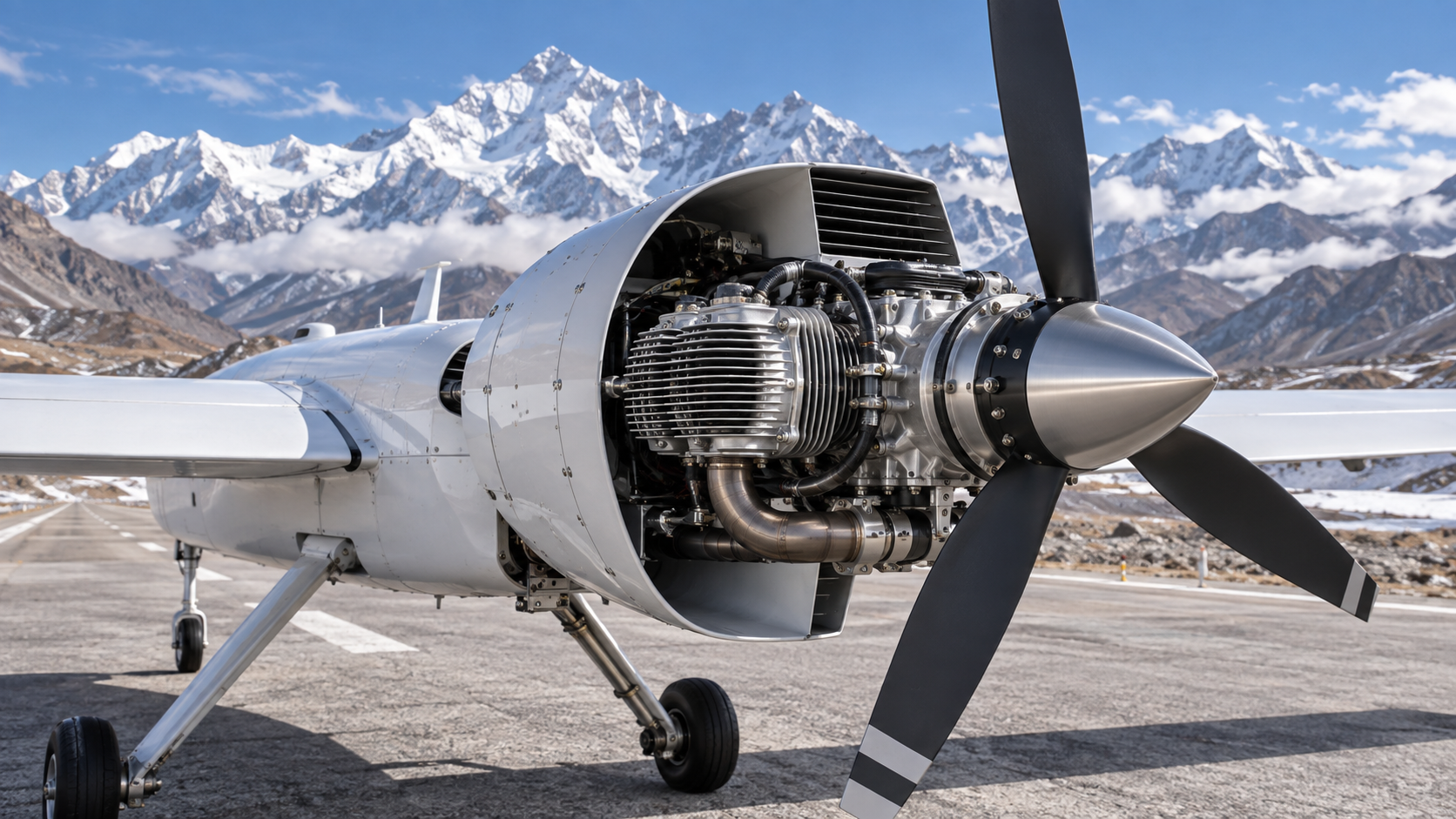
When a Custom UAV Engine Is Needed for High-Altitude Missions
High-altitude UAV operations expose weaknesses that may remain hidden in low-elevation testing. An aircraft can appear well powered during sea-level trials, then lose climb capability, throttle response, thermal margin, or payload flexibility when it is asked to work over mountainous terrain or at sustained altitude. For project managers, the issue is not simply whether an engine can run in thinner air. The real question is whether the propulsion system can support the intended mission with acceptable margins across the full operating envelope.
A Custom UAV Engine becomes necessary when a standard powerplant no longer matches the aircraft’s altitude profile, payload, endurance target, installation geometry, fuel arrangement, control architecture, or environmental conditions. Customization is not automatically the right answer. It adds engineering work, validation requirements, and coordination between airframe and propulsion teams. But where high-altitude performance is mission-critical, adapting the engine and its supporting systems early can prevent expensive redesigns later.
Why altitude changes the propulsion decision
Internal-combustion UAV engines depend on oxygen mass entering the cylinder. As air density falls, a naturally aspirated engine generally has less oxygen available for combustion at a given intake volume. This reduces the practical power available to turn the propeller. The effect is not isolated: propeller behavior, cooling airflow, mixture preparation, ignition stability, and climb strategy can all shift at the same time.
For a fixed-wing platform, reduced shaft power can mean a longer climb, a lower service ceiling, slower cruise, or an inability to maintain safe reserve power during turns and gusts. On a VTOL aircraft, the problem is often sharper. Vertical lift requires substantial power at the precise moment the aircraft has little tolerance for underperformance. Multi-rotor systems may also see a narrower margin between hover demand and the propulsion capacity available in thin air.
It is tempting to treat this as an engine-sizing exercise: select a larger displacement engine and move on. That can create new problems. A heavier engine changes the center of gravity, increases structural loads, may require a different propeller, and can consume the payload margin the project was intended to protect. High-altitude propulsion is therefore an integration problem, not merely a horsepower problem.
The signs that an off-the-shelf engine is no longer enough
A standard engine can be a sensible choice when the aircraft uses a proven airframe layout, operates within a familiar altitude range, and has conservative reserve margins. A custom approach deserves consideration when one or more project conditions make those assumptions unreliable.
- The UAV must take off, climb, or loiter at elevations where density loss materially affects power reserve.
- The mission combines high altitude with a demanding payload, such as mapping equipment, communications hardware, sensing modules, or mission-specific avionics.
- The aircraft needs an unusual installation arrangement because of fuselage dimensions, pusher or tractor configuration, VTOL lift modules, or center-of-gravity constraints.
- The expected temperature range introduces starting, cooling, lubrication, or fuel-vaporization concerns.
- The flight-control system requires defined interfaces for engine status, ignition, throttle actuation, telemetry, or emergency procedures.
- The program needs a repeatable production configuration rather than an individually adapted engine installation.
None of these conditions alone proves that a bespoke powerplant is required. They do indicate that a catalog specification should not be accepted without examining how the engine behaves in the actual aircraft. A propulsion package that is adequate for a short low-altitude surveillance mission may be unsuitable for a long-range mountain route, even when the nominal engine rating looks similar on paper.
Customization should begin with the mission, not the engine
The most useful starting document is a mission profile rather than a request for a particular engine model. It should define takeoff elevation, expected operating altitude, ambient temperature range, climb requirements, cruise condition, loiter duration, payload mass, fuel allowance, and required reserve. It should also describe whether the aircraft must restart in flight, operate from remote sites, or perform repeated launches in a narrow time window.
From there, the aircraft team and engine developer can examine the variables that affect the final configuration. Intake and mixture management may need to be adapted for the anticipated density range. A forced-induction concept may be evaluated in some programs, but it is not a universal remedy; it introduces its own packaging, thermal, control, and reliability questions. The appropriate solution depends on the operating envelope and the level of system complexity the program can support.
Propeller matching is equally important. The engine, reduction drive if used, and propeller must work together at the relevant airspeed and altitude. A propeller selected solely for static thrust can compromise cruise efficiency, while one optimized only for cruise may not provide the acceleration or climb performance needed after launch. In practice, the best choice often comes from balancing these phases rather than maximizing a single test condition.
Installation details frequently drive the project more than expected. Exhaust routing affects heat management and airframe protection. Fuel line routing, tank position, vibration isolation, starter arrangement, and service access influence field reliability. A compact engine that is difficult to inspect or remove may create more operational downtime than a slightly heavier unit designed around maintainability.
High-altitude risks that should be addressed before flight testing
Altitude testing should not be used as the first moment to discover basic propulsion mismatches. Flight trials remain essential, but many risks can be identified during requirements review, bench testing, installation analysis, and progressive ground runs. The objective is not to eliminate all uncertainty. It is to make uncertainty visible before it becomes a schedule issue.
Thermal management deserves particular attention. Cooler outside temperatures do not automatically mean an easier cooling problem. During a high-power climb, the engine may generate substantial heat while the reduced-density airflow carries heat away less effectively. The shape of the cowling, inlet and outlet areas, local pressure differences, and the location of heat-sensitive components all influence the outcome. A reliable installation needs measured validation rather than assumptions based on ambient temperature alone.
What a practical custom-engine program looks like
A well-managed customization program does not begin with a long list of optional features. It begins by freezing the decisions that matter most: mission envelope, mass budget, interfaces, fuel, propeller concept, installation space, maintenance philosophy, and acceptance criteria. Once these are stable enough, the engine supplier can evaluate whether an existing platform can be adapted or whether a deeper redesign is justified.
The distinction matters for schedule control. Adaptation may involve mounting provisions, intake and exhaust changes, electronic control interfaces, cooling arrangements, calibrated operating settings, or a revised propeller match. A ground-up engine development has a much broader validation burden. Project teams should ask for clarity on which parts are mature, which are application-specific, and what tests will demonstrate that the combined system meets the agreed requirement.
Acceptance should be written in mission terms where possible. Instead of requesting only a stated power rating, define the performance and operating conditions that must be demonstrated. Include starting conditions, sustained operating points, monitoring signals, vibration limits where applicable, fuel consumption assessment methods, inspection intervals, and documentation needed for the program. Exact requirements will vary with aircraft category, local regulations, and whether the application is commercial, industrial, or defense-related.
Choosing an engineering partner for the integration work
The right supplier is not simply the company that offers the largest engine range. High-altitude UAV work requires communication between propulsion engineers, airframe designers, flight-control specialists, and the people responsible for field support. A supplier should be willing to discuss constraints as directly as capabilities: what cannot be guaranteed without test evidence, which interface choices create risk, and which changes may affect delivery or qualification plans.
Shandong Shengsheng Electric Equipment Co., Ltd., based in Jinan, China, works in the research, development, and supply of UAV engines and unmanned propulsion systems for fixed-wing UAVs, multi-rotor platforms, VTOL aircraft, and other unmanned applications. Its technical foundation includes long-term collaboration with institutions such as Beihang University, Nanjing University of Aeronautics and Astronautics, Xi’an Jiaotong University, Air Force Engineering University, and Xi’an ASN Group.
That background is relevant because custom propulsion decisions benefit from both engine knowledge and disciplined production thinking. Shengsheng’s team includes specialists in mechanical engineering and internal-combustion engines, supported by aerospace and defense-sector advisors. The company has also contributed to the formulation of China’s national military standard, GJB, for aviation piston engines. For a project manager, such experience does not remove the need for application-specific verification, but it can support a more informed discussion of engine configuration, reliability processes, and integration requirements.
The decision is really about margin
A high-altitude UAV does not need a custom engine merely because it flies above a certain elevation. It needs one when the mission cannot tolerate the uncertainty created by a generic propulsion match. If payload, climb, endurance, thermal behavior, installation constraints, and control interfaces all sit near their limits, adapting the powerplant may be the lower-risk choice.
Before committing, assemble the mission profile, airframe constraints, propeller assumptions, environmental conditions, and required evidence of performance. Those inputs make it possible to determine whether a proven standard engine remains suitable, whether a configured variant is sufficient, or whether a fully custom UAV engine program is warranted. That is a more useful decision than selecting by headline power alone.
First class quality service and professional after-sales team.
Get in Touch
*We respect your confidentiality and all information are protected.