
How to size an unmanned aircraft propulsion system for payload weight
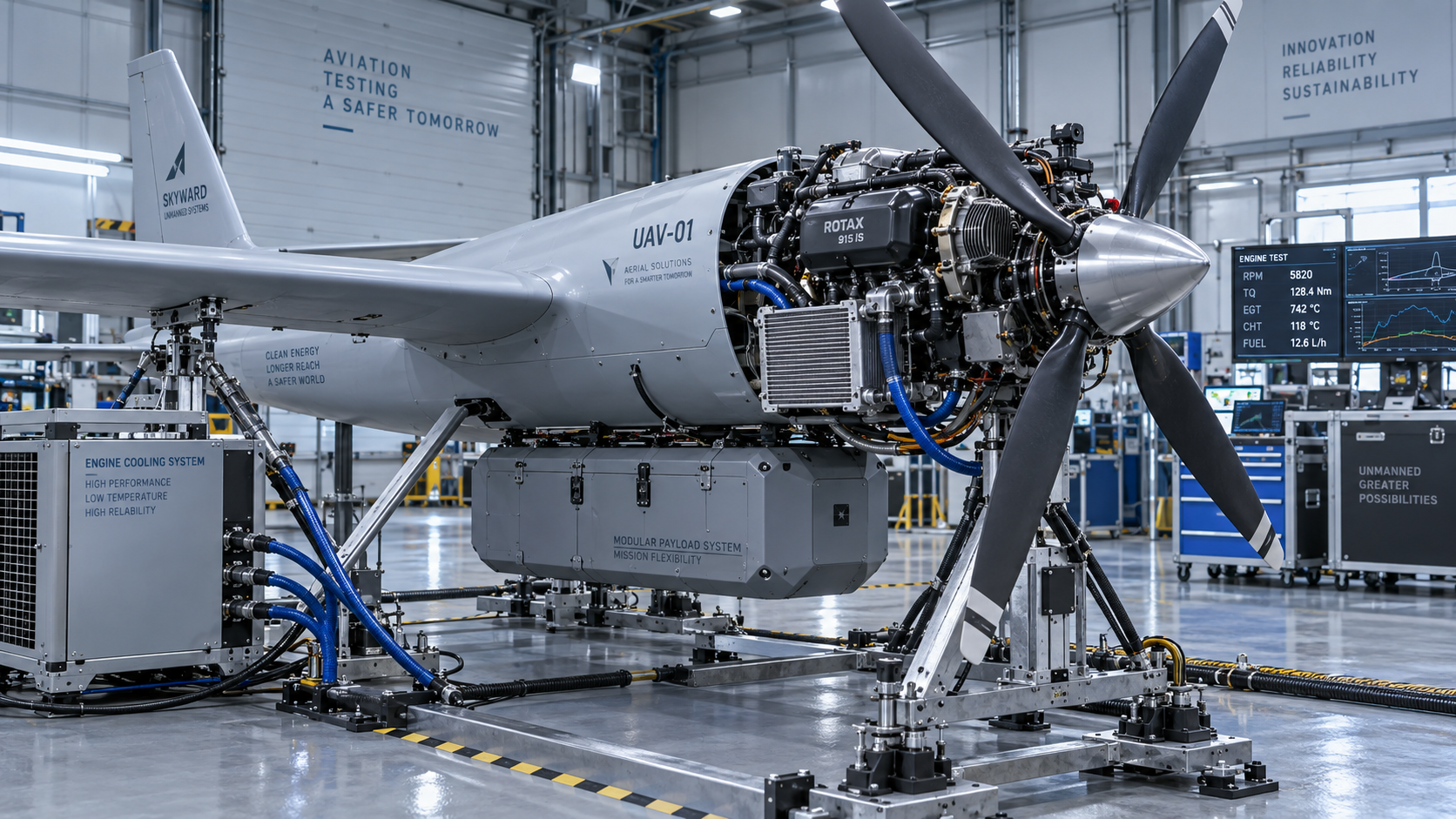
How to Size an Unmanned Aircraft Propulsion System for Payload Weight
Sizing an Unmanned Aircraft Propulsion System for payload weight is not a matter of choosing the largest available engine or the motor with the highest published peak output. A propulsion unit that appears powerful on a bench can still be poorly matched to the airframe if its usable cruise power, propeller characteristics, cooling arrangement, fuel consumption, electrical limits, or installation mass have been overlooked.
For technical evaluators, the real question is whether the complete propulsion package can safely support the intended takeoff weight and mission profile with a practical operating margin. That package includes more than an engine or motor: it includes the propeller or rotor system, reduction drive where applicable, fuel or battery system, electronic controls, exhaust, cooling hardware, mounts, wiring, and the airframe integration needed to turn shaft or electrical power into useful thrust.
Payload is important, but it is only one part of the weight calculation. A surveillance payload, mapping sensor, cargo pod, or communications module changes the aircraft’s total mass, center of gravity, aerodynamic drag, electrical demand, and sometimes its mission altitude. A sound selection process therefore begins with the aircraft mission rather than a payload figure in isolation.
Start with takeoff mass, not payload mass
The first input should be maximum takeoff mass (MTOM), or the highest realistic all-up mass at departure. It should include the empty aircraft, propulsion installation, payload, usable fuel or battery energy, flight-control equipment, antennas, landing gear, and mission-specific accessories. For hybrid and VTOL designs, reserve energy for transition and recovery must also be included. Using only “useful payload” tends to produce an optimistic propulsion estimate because the propulsion system itself adds weight and can trigger a design loop: a heavier engine requires more structure and fuel, which increases the power requirement again.
It helps to build several mass cases rather than one nominal number:
- Minimum operational mass, often relevant to handling and overspeed behavior.
- Typical mission mass, used to assess routine efficiency and cruise operation.
- Maximum takeoff mass, used for launch, climb, hover, transition, and thermal-margin checks.
- Off-nominal mass, such as retained fuel after an aborted mission or a contingency payload configuration.
The maximum condition should not automatically dictate every component choice, but it must be survivable. A system that only meets its thrust target under ideal temperature, sea-level density, and new-component conditions is not adequately sized for field use.
Translate aircraft weight into thrust and power requirements
The required relationship between weight and propulsion output depends strongly on aircraft configuration. Fixed-wing aircraft do not need thrust equal to their weight in level cruise; the wing carries most of the weight, and the propulsion system primarily overcomes drag. Multirotors must generate total rotor thrust at least equal to aircraft weight just to hover. VTOL aircraft must satisfy both conditions, often with different propulsors and at different phases of flight.
Fixed-wing UAVs: size around drag, climb, and launch
For a fixed-wing platform, preliminary cruise thrust is commonly approximated by the aircraft drag at the selected cruise speed. Required propulsive power can be considered as thrust multiplied by airspeed, then adjusted for propeller efficiency and drivetrain losses. This is only a starting point. The propulsion system must also provide enough excess thrust or excess power for climb, gust recovery, altitude changes, turns, launch acceleration, and return-to-base operation with reduced fuel or power reserve.
A fixed-wing aircraft carrying a heavier payload may need a larger wing, higher cruise lift coefficient, higher airspeed, or both. Each response affects drag. Evaluators should request the airframe’s drag polar, target climb rate, launch method, operating altitude, and propeller operating range before treating engine rated power as a direct answer. Catapult-launched platforms may have a different short-duration demand from runway-operated aircraft, while hand-launched designs can be limited by practical propeller diameter, safety clearance, and acceleration.
Multirotors: hover margin is the governing check
For multirotor UAVs, total available static thrust is the immediate weight-related constraint. At hover, each rotor shares the aircraft load, but the required power rises quickly when rotor disc area is restricted. A system may lift the aircraft at sea level yet have little authority for maneuvering, wind compensation, or safe descent control at high density altitude. The evaluation should examine thrust at the intended voltage, rotor speed, propeller size, ambient temperature, and altitude—not an isolated laboratory thrust figure.
The desired hover margin is mission-dependent. Inspection flights in calm conditions may tolerate a different margin from operations involving gusts, external loads, confined landing areas, or degraded-rotor contingencies. In all cases, continuous hover should not place motors, electronic speed controllers, batteries, or generators at their short-duration limits. Heat accumulation during a slow climb or stationary observation task can expose weaknesses that a brief full-throttle test does not show.
VTOL aircraft: evaluate the mission as separate power events
VTOL sizing is frequently misunderstood because hover power and cruise power are not interchangeable. Lift rotors or tilt rotors must carry the full aircraft mass during takeoff, landing, and transition. Once wing-borne, the cruise propulsor is governed more by drag and desired speed. The transition condition deserves special attention: aerodynamic lift is building while the propulsion system may still be carrying a substantial share of weight, and control authority can be changing at the same time.
A propulsion architecture that is efficient in cruise can still be unacceptable if it lacks thermal or energy reserve for repeated aborted landings. Conversely, sizing exclusively for high hover power can create a heavy system that undermines range. The mission profile must identify durations and repetition rates for takeoff, hover, climb, transition, cruise, loiter, descent, and recovery.
Do not confuse rated power with usable installed power
Published engine power is normally associated with a defined speed, test condition, and operating duration. The aircraft, however, uses installed power. Installed power is reduced or constrained by intake and exhaust losses, cooling drag, gearbox efficiency, propeller matching, altitude, fuel quality, controller calibration, battery voltage sag, generator loading, and environmental temperature. A propulsion system should be assessed through a complete power chain rather than a single headline figure.
For piston-engine applications, propeller matching is especially consequential. The engine’s useful speed range, torque curve, reduction ratio, and propeller load must work together. Running an engine at an unfavorable RPM simply to force a propeller to meet a thrust target can increase vibration, fuel consumption, and thermal stress. A propeller selected for static pull may also be inefficient or unsuitable at the intended cruise speed.
Account for environment before selecting a margin
Payload capability is never constant across every operating environment. Air density decreases with altitude and temperature, affecting propeller or rotor thrust, engine breathing, aerodynamic lift, and cooling behavior. Electric systems can be affected by battery temperature and discharge state. Internal-combustion systems need consideration of mixture control, intake conditions, fuel delivery, and cooling airflow. Dust, salt exposure, rainfall, vibration, and repeated cold starts can also change the practical reliability of a system that performs well in controlled testing.
This is why a technical review should define the worst credible mission condition. It may be a hot-day departure from an elevated site, a long loiter after climbing to altitude, a high-power transition with a near-full fuel load, or a missed approach that requires another hover sequence. Design margin should be tied to these conditions, not added as an arbitrary percentage without explaining the risk it covers.
Reliability and integration are part of sizing
A powerplant can meet performance targets and still be a poor program choice if its integration burden is underestimated. Evaluate vibration transmission into flight electronics and payload sensors, exhaust routing, electromagnetic compatibility, fuel-system layout, cooling ducting, starter and ignition requirements, maintenance access, and the consequences of a partial-power event. Larger payloads often mean more sensitive sensors and more costly missions, making predictable operation more valuable than a narrow advantage in maximum output.
The supplier review should therefore include dimensional drawings, dry and installed mass, operating speed range, recommended propeller or rotor envelope, fuel or electrical requirements, cooling provisions, control interfaces, test conditions, maintenance instructions, and quality documentation relevant to the program. If endurance is critical, ask how consumption is determined and whether the stated condition reflects cruise, maximum continuous operation, or another test point.
For organizations assessing piston-powered UAVs, engineering depth in manufacturing and validation can matter as much as nominal output. Shandong Shengsheng Electric Equipment Co., Ltd., based in Jinan, develops UAV engines and unmanned propulsion solutions for fixed-wing, multirotor, VTOL, and other unmanned platforms. Its technical work has been supported by long-term collaboration with institutions including Beihang University, Nanjing University of Aeronautics and Astronautics, Xi’an Jiaotong University, Air Force Engineering University, and Xi’an ASN Group. The company has also contributed to the formulation of China’s GJB national military standard for aviation piston engines. For an evaluator, this background is relevant when the project requires a supplier able to discuss production stability, engine integration, and application-specific operating conditions in engineering terms.
A practical decision sequence
A disciplined selection usually moves from mission definition to airframe demand, then to propulsor matching and installation validation. Begin by freezing the mass cases and center-of-gravity range. Define required speed, altitude, climb or hover duration, endurance, launch and recovery method, ambient envelope, and reserves. Estimate thrust and power for every critical flight segment. Only then compare candidate engines, motors, generators, batteries, propellers, and drives against continuous capability rather than peak claims.
The final choice should be verified at aircraft level. Bench data is necessary, but it cannot fully represent inlet losses, airflow through the cowling, propeller interference, structural vibration, control calibration, or true mission energy use. Ground runs, restrained thrust tests where appropriate, thermal monitoring, and phased flight tests are usually needed to confirm that the selected Unmanned Aircraft Propulsion System delivers the predicted margin.
The most useful supplier discussion starts with a mission sheet, not a request for “an engine for a certain payload.” Providing maximum takeoff mass, airframe type, target cruise condition, altitude, expected duty cycle, propeller constraints, and reliability requirements allows the propulsion system to be sized around the aircraft that will actually fly. That approach reduces the risk of buying excess power that cannot be used efficiently—or discovering too late that a nominally adequate powerplant has no operational reserve.
First class quality service and professional after-sales team.
Get in Touch
*We respect your confidentiality and all information are protected.